
Why Almost Every Anime or Manga Fan Gets Confused
At some point, every reader or viewer pauses and wonders:
“Does this actually count?”
A character appears and disappears.
A dramatic arc ends, yet nothing seems to change.
An episode feels important — but is never mentioned again.
This confusion isn’t accidental. It’s built into how anime and manga are produced, adapted, and consumed. And unless you understand canon vs filler, it becomes hard to know what truly matters to the story and what exists only for pacing, production, or expansion.
This article isn’t about telling you what to skip blindly.
It’s about helping you read and watch with clarity.
What Does “Canon” Mean in Anime and Manga?
In simple terms, canon refers to the material that is officially part of the story’s true continuity.
Canon answers one core question:
“Did this actually happen in the story’s universe?”
If an event is canon:
- It has lasting consequences
- It shapes characters long-term
- It is acknowledged in later chapters or episodes
In most cases:
- Manga canon comes directly from the original creator’s work
- Anime canon is an adaptation of that material
However, canon is not just about format — it’s about authority.
Who Decides What Is Canon?
Canon is usually determined by:
- The original author or creator
- The original source material (manga or light novel)
- Official confirmations through consistent continuity
If the story keeps building on it, referencing it, and respecting it — it’s canon.
What Is Filler — and Why Does It Exist?
Filler refers to content that exists outside the original story progression.
It does not mean “bad.”
It means non-essential to the core narrative.
Filler content usually:
- Does not affect long-term plot
- Does not permanently change characters
- Is rarely referenced again
Why Filler Was Created in the First Place
Historically, filler existed because anime production often caught up to the manga too quickly. Studios needed time for new chapters to be written, so they created original episodes to avoid overtaking the source material.
Today, filler still exists — but for different reasons:
- Maintaining seasonal release schedules
- Extending popular series
- Allowing production gaps without stopping broadcasts
This is why modern filler can sometimes feel higher quality, even if it doesn’t move the story forward.
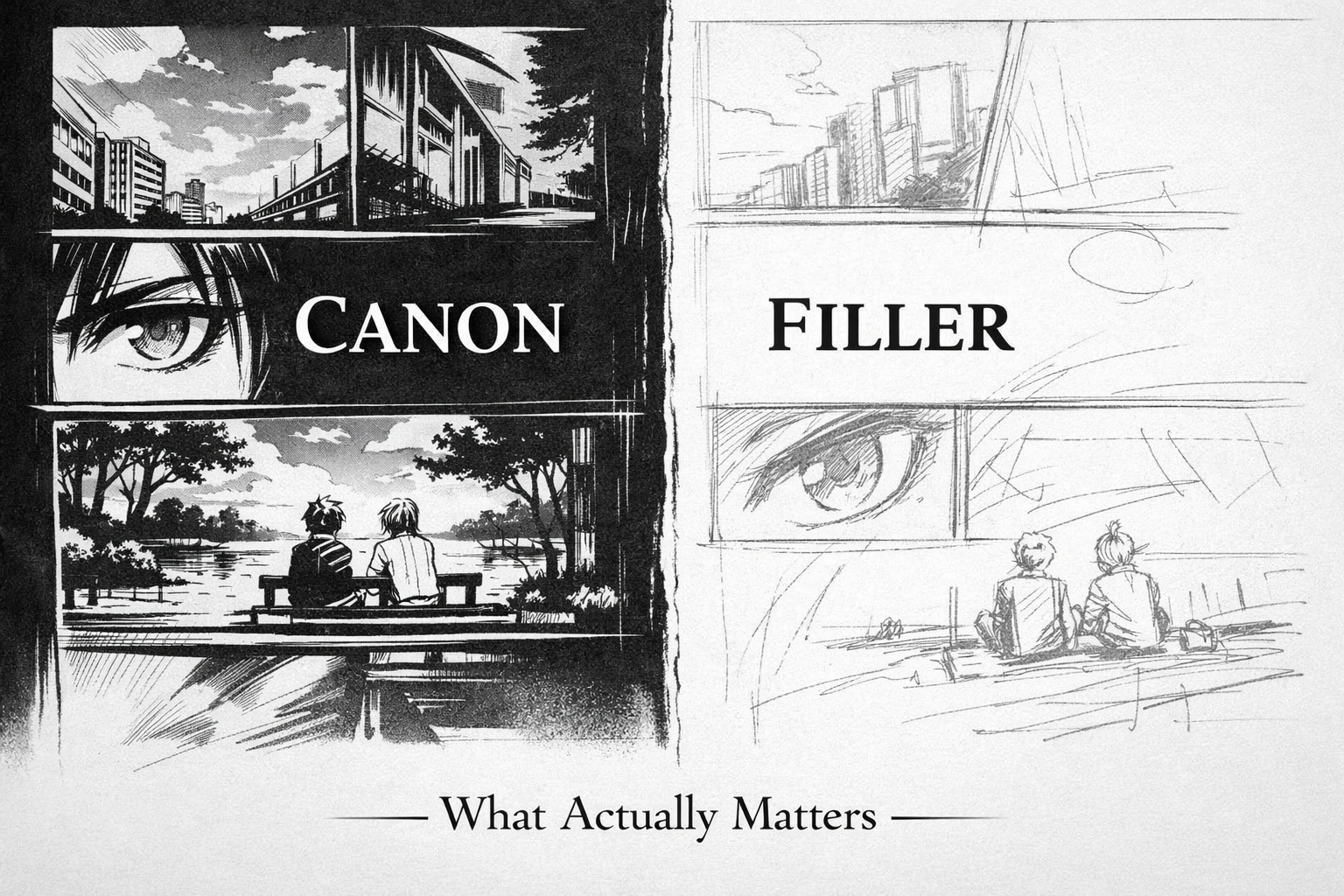
Canon vs Filler: The Core Difference (In Plain Language)
The real difference isn’t about quality — it’s about impact.
- Canon changes the story
- Filler preserves the story as it is
Canon moves the narrative line forward.
Filler runs alongside it without altering its direction.
That’s why filler arcs often end where they began — emotionally and structurally reset.
Why Filler Often Feels Important (Even When It Isn’t)
Many fans assume filler is meaningless. That’s not entirely true.
Filler can:
- Add emotional moments
- Explore side characters
- Slow the pace for reflection
But because filler cannot contradict or reshape canon, it operates within strict boundaries. It may feel deep, but it cannot leave permanent marks.
This is where confusion begins — emotional weight does not always equal narrative importance.
Why This Distinction Matters to You as a Reader or Viewer
Understanding canon vs filler helps you:
- Follow the story without confusion
- Avoid burnout in long-running series
- Know which moments define the world and characters
- Decide what’s essential based on your time and interest
It turns passive watching into intentional reading.
And that’s where the experience improves.
Types of Canon You’ll Encounter & How to Identify Filler Confidently
By now, the basic difference between canon and filler is clear.
What usually isn’t clear — even to long-time fans — is that canon itself is not a single, rigid category.
Modern anime and manga storytelling has evolved. Adaptations are closer, authors collaborate more with studios, and continuity is handled with far more flexibility than it was a decade ago. That’s why many viewers struggle to label something as “canon” or “filler” today.
This section helps you navigate that gray area without guesswork.
The Different Types of Canon You’ll Actually Encounter
Primary Canon (The Foundation)
This is the core story as created by the original author.
- Typically the manga or light novel
- Establishes all major events, rules, and outcomes
- Everything else is measured against this
If something contradicts primary canon, it cannot stand as true continuity.
Adaptation Canon (The Interpreted Layer)
This includes material created during adaptation that:
- Expands scenes already present in the source
- Adds detail without changing outcomes
- Clarifies pacing or transitions
These moments usually fit cleanly into the original timeline and are rarely disputed by fans.
They matter — but they don’t redefine the story.
Mixed Canon (Where Confusion Starts)
Some arcs or episodes:
- Combine original material with new content
- Rearrange events while preserving outcomes
- Add scenes that feel important but remain unreferenced later
Mixed canon often causes disagreement because parts of it align with the source while others don’t. This doesn’t make it wrong — just contextual rather than foundational.
Soft Canon (Acknowledged, Not Essential)
Soft canon includes elements that:
- Are never contradicted
- Don’t affect future plot decisions
- Exist mostly for flavor or depth
These details may be recognized in official material but are not required to understand the story moving forward.
Think of soft canon as optional context, not mandatory reading.
How to Tell If an Episode or Arc Is Filler (Without External Guides)
You don’t need episode lists or charts if you know what to look for.
1. Watch for Consequences
If events leave no emotional, political, or relational impact later, they likely fall outside core continuity.
2. Observe Character Growth Patterns
Canon growth is cumulative.
Filler growth often resets.
3. Notice Pacing Shifts
Sudden tonal changes or isolated conflicts often signal non-essential content.
4. Track New Characters Carefully
Canon characters echo forward.
Filler characters often vanish.
5. Check Continuity References
Canon events are remembered.
Filler events are quietly left behind.
Why This Is Harder in Modern Anime
Older anime made filler obvious.
Modern adaptations blur the lines intentionally due to closer author–studio collaboration and higher production standards.
Impact and continuity now matter more than presentation.
Why Knowing This Improves Your Experience
Understanding these layers:
- Prevents unnecessary confusion
- Helps you pace long series intelligently
- Allows you to choose depth over volume
Instead of asking “Is this canon?”
You start asking “What role does this play?”
Can Filler Ever Matter? Manga vs Anime and Where Confusion Deepens
At this point, it’s clear that not all story content carries equal weight.
Yet many readers still ask:
“If filler doesn’t change the story, why does it sometimes feel important?”
Can Filler Ever Actually Matter?
Yes — emotionally, not structurally.
Canon decides what happens.
Filler influences how it feels.
That’s why some filler arcs are beloved even though they leave no permanent mark.
When Filler Adds Value
Filler works best when it:
- Reinforces existing character traits
- Expands established relationships
- Explores themes the main story moves past quickly
It adds context without rewriting fate.
When Filler Undermines the Experience
Problems arise when filler:
- Breaks momentum
- Introduces false stakes
- Conflicts with established characterization
The issue isn’t creativity — it’s structural limitation.
Why Manga Rarely Has Filler
Manga:
- Comes directly from the creator
- Controls its own pacing
- Doesn’t need to stall for production
What feels like “filler” in manga is usually intentional reflection, not padding.
Why Anime Complicates Canon
Anime must balance:
- Broadcast schedules
- Episode counts
- Source material availability
This leads to expansions that feel canon but don’t carry consequences.
Anime-Original Content: Always Filler?
No.
Some original scenes:
- Expand canon
- Support characterization
- Improve clarity
Only content that creates alternative outcomes truly separates itself from canon.
How Experienced Readers Think About It
They stop asking:
“Should I skip this?”
And start asking:
“What does this add?”
That shift removes frustration.
Should You Skip Filler? Misconceptions, Modern Relevance & a Clear Decision Framework
After understanding structure, the real question becomes practical:
How should you approach filler as a reader or viewer today?
Should You Skip Filler?
There is no single correct approach.
Skipping filler makes sense if:
- You’re focused on plot continuity
- You’re catching up on a long-running series
- You want the creator’s core narrative without interruption
Watching filler makes sense if:
- You enjoy character downtime
- You’re attached to the world itself
- You value atmosphere as much as progression
The mistake isn’t skipping or watching.
The mistake is not knowing which one you’re doing.
Common Misconceptions About Canon and Filler
“If it’s animated, it must be canon.”
Production quality does not equal narrative authority.
“Filler means bad writing.”
Many filler episodes are well-written; they’re just structurally limited.
“All anime-original content is non-canon.”
Some original scenes expand canon without redefining it.
“Canon is always better.”
Canon drives the story, but filler often carries the quietest emotional weight.
Why Canon Still Matters More Than Ever
In an era of:
- Remakes
- Sequels
- Reboots
- Extended universes
Canon defines what carries forward.
It tells you:
- Which events shape the future
- Which character changes endure
- Which moments truly matter long-term
Canon is the spine.
Everything else attaches to it.
A Simple Framework to Decide What Actually Matters
Ask yourself:
- Does this event affect future arcs?
- Is it acknowledged again?
- Does it permanently change a character?
- Is it rooted in the original source’s intent?
If most answers are no — it’s optional.
Not useless. Optional.
Frequently Asked Questions
Final Thought
Canon vs filler isn’t about gatekeeping stories.
It’s about understanding structure, valuing your time, and engaging with stories deliberately.
Once you see what truly carries weight, confusion fades —
and the story becomes clearer, deeper, and more intentional.